Montreal Brain Imaging Study Shows Reduced Reactivity with Mindfulness
Mindfulness largely refers to a state of awareness characterized by a particular attitude of acceptance and non-judgement towards ‘events’ occurring in the realm of our attention.
These events may constitute thoughts, feelings, physical sensations, emotions, recursive thinking patterns, etc. The challenge in cultivating mindfulness lies in acknowledging these thoughts/feelings/sensations/perceptions, instead of reacting to them in habit-formed ways. Therefore, mindfulness allows us to adopt a more detached perspective on our experiences, promoting greater objectivity in selecting responses and behavior.
Mindfulness is cultivated through the practice of meditation, and has its roots in ancient Eastern traditions. Research has shown that mindfulness reduces the extent to which we react to emotional events, which is reflected not only in the way we perceive these events but in the way our body physically responds to them.
This may potentially explain why mindfulness is beneficial when introduced in treatments targeting depression and anxiety. The way in which the effects of mindfulness on emotional events are reflected in brain function, however, is not clearly established.
Therefore, our research group at Université de Montréal (laboratory of Dr Mario Beauregard) conducted a study examining brain function changes underlying a mindfulness state of awareness while processing emotionally charged pictures.
To do this, we examined a group of individuals having practiced meditation for more than 1000 hours, and another comparison group with no prior experience in meditation (but which was trained for one week before the experiment). The participants viewed pictures depicting negative emotional (eg.: war scenes), positive emotional (eg.: a grandfather smiling and hugging his grandchild) and neutral content (eg.: a common object, such as a lamp). At the same time, their brain activity was recorded inside an MRI scanner. Each group viewed these pictures in a state of mindfulness, as well as in a regular (non-mindful) state of awareness.
Essentially, both experienced meditators and non-meditators reported that they felt less emotionally aroused from the pictures when viewing them in a mindful state of awareness than when they were not in a mindful state.
Also, brain function recorded from the long-term practitioners in comparison to the non-meditators revealed the following results. While viewing the emotional pictures in a mindful state of awareness did not reduce activity in a relatively ‘primitive’ fear and arousal-related brain structure, i.e. the amygdala, mindfulness was related to reduced activity in thought-related brain areas, i.e. within the prefrontal cortex.
This potentially indicates that, with long-term meditation experience, the mechanism through which mindfulness attenuates arousal to emotional events is not attained through the initial primitive reaction, but through the secondary thoughts and judgements triggered by arousing events.
This interpretation however, needs to be validated with behavioral tasks specifically assessing mindfulness and thought-related elaboration towards emotional events.
In a second report, we also observed differences between our group of long-term meditators and non-meditators in the way their brain activity was organised during a state of rest, i.e. when participants were not engaged in a specific task. Thus, this may indicate that meditation is related to brain organisation changes which extend beyond a meditative state of awareness per se.
It is important to point out, however, that cause and event conclusions cannot be derived from the results of these studies, and that further research projects examining a group of participants before and after having acquired mindfulness experience are needed to support our findings.
Nonetheless, our studies shed light onto the brain mechanisms operating when individuals experience emotional content in a mindful way. As researchers and scientists persist in studying and uncovering these processes, we will gain a better understanding of the impact that emotional experiences and meditation have on our psyche, our body, and our brain.
Finally, with a better understanding of these processes, mindfulness can be more efficiently implemented into treatment options for disorders related to stress and emotional lability.
If you haven’t checked it out yet, I highly recommend Michael Pollan’s 2018 book How to Change Your Mind. It’s a deep dive into the history, research, and resurgence of psychedelics as a valid modality of psychiatric treatment.
In chapter 5, Pollan explores what brain imaging has been teaching us about the effect of psychedelics on the brain. One of the most notable findings is that psychedelics lessen the activity of a series of neurological pathways in the brain known as the Default Mode Network (DMN).
The DMN serves a multitude of functions in navigating our daily lives and plays a major role in how we define the self (our definition of who we are), very similar to what is often referred to as the “ego.”
The DMN is also often referred to by psychologists as “The great orchestrator of the brain.” Let’s explore how psychedelics, like ketamine, affect these DMN functions and discuss why these effects can facilitate healing.
Daydreaming
Where does the mind go when it is not occupied by an immediate task?
Individuals suffering from depression may default to ruminations or feelings of worthlessness. People suffering from substance abuse may default to thoughts of guilt or the urge to use. Those battling eating disorders may default to obsessions with control and relentless thoughts about body image. People suffering from anxiety may default to an unrelenting need to get things done and have everything perfect.
This list could go on and on. For individuals whose minds tend to wander to such places, psychedelic medicine may help. Ketamine and other psychedelic medications reduce the activity of the DMN, allowing the mind to daydream in a different way and form new pathways for the brain to use.
A psychedelic experience can act as welcome reprieve from the unrelenting negative thoughts that many battle every day. It allows for a chance to cognitively and emotionally interact with life in a new way, and see ourselves with a fresh perspective.
The Self
The way each of us defines ourselves is wildly complex. In our brains is the wiring for thousands and thousands of rules and definitions that make up our unique experience of self (who we are).
Embedded in our sense of self are the rules and defense mechanisms for how we deal with things like guilt, shame, grief, and trauma. Many of our defense mechanisms were written in our minds when we were very young and entirely without our awareness.
Defense mechanisms that may have protected us as children may now only serve to drive our negative self-image. In a psychedelic experience, as the DMN is dialed down, the overpowering definitions of self are softened. This allows us to see and possibly even define ourselves in a new way. The ruts and trenches of how we think about ourselves are filled in and new definitions of who we are materialize and are given a chance to flourish.
The Great Orchestrator
Our brains receive and process enormous amounts of information. As a child, this information is not filtered. Over time, however, our brains learn to create short cuts and filter out extraneous information through a process called specialization.
This process is seen in language acquisition and motor skill development, as well as an assortment of other skills essential to daily life. As a part of specialization, the DMN comes online and orchestrates the cognitive short cuts or filters that are essential to daily life.
The downside to this is that the cognitive short cuts and filters imposed by the DMN make it more difficult to see the forest from the trees, so to speak. If we are perpetually seeing ourselves or the world in a negative way, then turning down the DMN through the use of psychedelics may facilitate new insights into life and a reframing of a negative self-image into a more honest and kinder one.
Mental health problems steal peace away from us in a myriad of ways. One of the most powerful tools for combatting this is found in our perception. Many people with mental illness wish they could change their reality.
To one degree or another, we all have a list of “I could-be-if…” statements. The problem with these statements is that they often give our power away. The world is never going to be perfect, but there is more than enough joy in it to have a rich and fulfilling life regardless of circumstances.
I once heard a man in a Narcotics Anonymous meeting share that he felt addiction could be defined as the inability to accept life on life’s terms. I think this profound statement can be expanded beyond the world of addiction to the struggles of life faced by many.
Ketamine may be a viable tool that enables us to come to terms with the world as it is. By quieting the DMN and its rigid response to the world, ketamine facilitates seeing our world and the suffering in it in a new way.
About the author
Reid Robison, MDA MBA is the Chief Medical Officer at Novamind. He is a board-certified psychiatrist who was named Best Psychiatrist in Utah by Salt Lake City Weekly’s Best of Utah Body & Mind 2020.
Dr. Robison is the co-founder of Cedar Psychiatry and serves as the Medical Director for the Center for Change, a leading Eating Disorder center. He was previously a coordinating investigator for the MAPS-sponsored MDMA-assisted psychotherapy study of eating disorders.
Psychedelics & Safety Considerations
It’s common for people to have questions about the safety of psychedelic drugs and whether there are risks associated with them. Fortunately, classic psychedelics have little to no abuse potential. In fact, studies suggest they might even be anti-addictive. Even in vulnerable populations, it’s rare for complications like psychosis to arise from the use of psychedelics.
That being said, psychedelics may not be for everyone—which is why we take such great precaution before proceeding down the psychedelic path at our clinics.
What screening is done before deciding on psychedelics?
We only use psychedelics when there is a mental health-related diagnosis on record. We also complete thorough medical and psychiatric screening including reviewing pertinent factors such as personal or family history of psychosis and any history of substance abuse. Only after these precautions are in place do we consider psychedelic-assisted therapy.
Are these drugs safe?
According to many studies, the short answer is YES. Psychedelics have significantly lower risks than alcohol, cannabis, tobacco, and other drugs. Data from a study of psilocybin found that cases of mental health complications following a psychedelic are rare (<.1%), even in vulnerable populations (<.2%), and rarer still with proper screening. Another notable study, examining the classical (serotonergic, or 5-HT2A receptor agonists) psychedelics, LSD, psilocybin, & mescaline, found that no evidence of increased rates of mental health problems, and psychedelic use has been associated with reduced psychological distress and suicidality. Additionally, studies examining use patterns in humans & self-administration in animals suggest that classic psychedelics possess little or no abuse liability and may even be anti-addictive. These conclusions come from a comprehensive review of several kinds of psychedelic compounds, including classical psychedelics (psilocybin, LSD, & mescaline), indirect 5-HT agonists, (e.g., MDMA), NMDA antagonists, and κ-opioid receptor agonists (KOAs).
Why do some people experience brief psychotic episodes even days after use?
There are several factors that can play into this. As a general guideline, people with cognitive & emotional conditions associated with disorganized or diminished ego strength are not good candidates for psychedelics. Regardless, however, the short-term psychological effects that accompany psychedelic use are profound. Sympathetic nervous system arousal may occur both because of fear, and from direct effects of the drugs--particularly during the initial phase of sessions when barriers between physical senses dissolve; touches, smells, and tastes can take on sounds, shapes and colors. Proper supervision is also important. These drugs’ effects are sufficient to require that professionals skilled in managing adverse effects are present, for safety & to guide patients through their experiences. Additionally, when taken without adequate preparation and when surroundings are anxiety-provoking—either physically uncomfortable or emotionally intimidating—the psychedelic experience predictably results in fear, a prolonged sense of dread, or full panic. Conversely, in controlled settings with elements of soft light, art, and appropriate music, or nature, and gentle, compassionate people, such adverse reactions are rare.
What conditions can Ketamine-Assisted Therapy (KAT) treat?
Depressive disorders
Post-traumatic stress disorder, post-traumatic stress and anxiety
Addictive disorders, including substance use and behavioural
What conditions are not suited Ketamine-Assisted Therapy at Numinus?
Absolute Contraindications - KAT is not a fit for those with the following conditions:
Allergic reaction to ketamine
History of ketamine abuse
History of stroke or brain aneurysm
Uncontrolled high blood pressure
Acute Angle Glaucoma
Uncontrolled thyroid disorder
History of mania/bipolar 1
Age 14 and under
Current diagnosis of schizophrenia, schizoaffective disorder, major depressive disorder with psychotic features, psychotic disorder
Pregnancy (individuals who can become pregnant must use contraception if sexually active)
Relative Contraindications - We can some times treat those with the following conditions, on a case-by-case basis, with additional medical support:
Active or unstable substance use disorder that is not an indication for treatment will be evaluated on a case by case basis by the screening physician
Jamie synthesizes history, psychology, neuroscience, and anthropology in order to create techniques and cultural practices centred around transforming human beings through non-ordinary states. Those practices include breathing techniques and psychedelics.
Jamie and Dr. Joe spoke about:
The breakdown of the traditional ways of making meaning
The social, political, psychological, and environmental consequences of this breakdown
Jamie’s design principles for a new meaning-making operating system
The most reliable and accessible sources of healing, inspiration, and connection
How we can implement this approach to building sustainable communities
Let’s start with sort of the premise for Recapture the Rapture and what I understand what you’re calling this sort of crisis of meaning that a lot of us are feeling a little kind of disoriented or suffering because the processes or the infrastructures that we use to sort of make meaning out of our complex lives have really been kind of shaken. And many of us are feeling a bit lost around that. So can you just tee that up for us?
Yeah, for sure. I think what we’re continuing to see even more and more and more of it, like even in this latest round we’re supposed to have vaccines and everybody can be safe and back to summer and then like, ‘oh no we have breakthrough cases, but no, there are no breakthrough cases.’ Actually, there’s whole a lot of hell of a lot more than we thought there were not. What we do with kids? Do we send them back? I was even having this conversation with our kids over the weekend. Because our daughter goes to school in Palo Alto, super on the ball, like maximum lockdown health provisions, and our son is going to school in Colorado. We’re here in Austin, which is in Texas, which is like a wheels off situation. And he was talking about like at this point, you cannot even tell whose side someone is on as to whether they’re wearing a mask or not wearing a mask. Like at one point it was a relatively clear division. It was a tribal identification. Now you have no idea what even the signs and the signifiers of our public actions or what ideological camps everyone is in. It is a complete epistemological train wreck, but also a socio-cultural, psychological one.
We didn’t end up in this particular mess solely or exclusively because of a particular coronavirus. We’ve been on this slide for the last couple of decades and radically intensified over the last five, which has been and maybe even more. I think you can for sure say two thousand eight was also like a massive disillusioning, but then throw it into the 2016 election onwards.
And what we have is that basically people are orienting their assumptions on life, the universe and everything from organized religion. That was one point that has been dwindling rapidly. And then for the last four hundred years plus we had this experience of modern liberalism, civil rights, nation states, private property, markets, democracy, that kind of bundled gig, including academic institutions, research, science, empiricism, all of that. And that, too, has been kind of crumbling.
And those are the two pillars of meaning. One point to point out is that the roof has been caving in as far as any shared reality we might have been experiencing. Rather than us all becoming grown up, rational, evidence based meritocrats or something that maybe like the Sam Harris and the Christopher Hitchens might have once forecast, we’re actually getting sucked to the extremes into fundamentalism, like doubling down on belief systems and not just traditional religious fundamentalism, anti-vax fundamentalism, populist fundamentalism, take your pick.
There’s all sorts of different narratives, sacred and secular, old and new, that are showing up where people are just doubling down on a rigid belief system versus some form, some form of more provisional sensemaking. So fundamentalism on one side or nihilism on the other. Just burn it all down, blow it up, what the fuck, who cares, let’s party or let’s riot. I mean, very fight club, right, in that sort of sense and diseases of despair, which is obviously a lot of the world. You look into the rise in addiction, anxiety, depression, suicides, all of the things that you would expect when people are unmoored from their surroundings. And of course, this isn’t happening in a vacuum.
This is happening at a time of accelerating exponential change, both better and worse, which is also really hard. And most people put all their belief systems onto one or the other. It’s either like Steven Pinker and Ted talks exponentially better, Matt Ridley. Or the doom and gloom naysayers, Extinction Rebellion and and any others pointing out the decline of civilization and or survivability. And you’re like, wait, which is it? It’s both. And they’re both exponential.
So which way this goes is going to be a crapshoot to the very last minute. And who do I look to to tell me where I should go? Oh, they’re all dead or gone or have abandoned their posts. So it’s every man for himself and do your own research. So that’s kind of the setup, which is we’re in a tight spot and someone broke our dashboard. So how do we find our own cosmic positioning system to reorient to what must be done? Because I think the most the worst thing we can be doing right now is fucking nothing, because we’re in that agitated, irritated, bored state. Like, we need to get off that dime and be moving in whatever direction we’ve chosen.
So you are orienting us or trying to inspire us into a new kind of operating system for making meaning. From meaning 1.0, you have identified three key processes or three key mind states: inspiration, healing, and connection. And I’ll let you talk about that and then continue down towards the Alchemist Cookbook.
There’s an awful lot of utopian thinking in general. If you look at anybody from whether it’s true old school, Alpha and Omega, Judeo-Christian stuff, like there’s going to be the Armageddon and the Rapture or any of those kind of things, that old school stuff, all the way to techno utopianism like Ray Kurzweil. I’m going to upload our consciousness to computers. To blockchain and seasteads. ‘We’re going to disrupt the nation state and we’re going to create our own little communities or civilizations.’ And maybe they float. Maybe they don’t. Maybe they’re in–it is not Croatia. It’s Estonia. One of those Eastern European bloc countries. They have some unclaimed land that is potentially going to be a libertarian crypto paradise. Or the psychedelic renaissance or trance tech like neuro link and implants or immersive VR.
There’s always the, ‘Yes, this is ugly. Yes, this is hard, but there’s some hockey stick redemption at the other end of this.’ And this also shows up in info marketing and self-help and new age and pop psychology. ‘Let’s poke your pain points and you get irritated and agitated. And then we offer you something whether it’s a workshop or a pill or a meditation practice in just seven minutes and then you’ll be delivered.’ And that is such a deep trope, both of Western thought, the Alpha and the Omega, the beginning and the end. But it shows up in communism. It shows up across two thousand years plus of Western thought. But then it was metastasized and weaponized by marketing in the 20th century.
And Tim Wu, the guy who wrote The Master Switch and tons of other stuff. He is a professor and thought leader. He also wrote a book called The Attention Merchants. And it’s basically outlining the genesis of 20th century marketing, like how do we get to Mad Men? How do we get to Don Draper? And the short answer is a bunch of down on their luck literal snake oil salesmen and washed up former preachers. ‘You have bad breath? You’ve got to try Listerine. You’ve got dandruff? Try head and shoulders.’
And then here’s your shot at redemption, in a product, a package, a pill. And that is so entrenched in everything, including the full hijack of the spiritual marketplace. We are almost hard wired to believe that there is an up and out play if only we can find it or buy it. Many of those end up being pathological because if the ends or heaven on earth or off it and the means are always, always justified, and there’s all kinds of spiritual bypassing, there’s all sorts of disassociation from the here and now and often our social and ethical responsibilities to others and ourselves and the whole thing.
That was a long windup to point out that the model of, hey, there’s this three legged stool or flywheel that is the human experience: inspiration, healing and connection. And we never get out of that. We never get out of the endless cycle of getting up to the high ground, remembering what we’ve forgotten, being informed and inspired, if we’re lucky–only to go down into the depths of our brokenness and either get crushed by life events and tragedies. Then we’re forever doing that.
And that sense that redemption lies not in getting to the mountaintop and camping out there because nothing lives up there, you can visit. You can put some prayer flags up there, but you need to get back down in the valleys, right. So there is no end to this. It’s forever. We’re forever being propelled forward from our life of highs and lows. And together, life is kind of tragic. That’s inescapable. That’s Buddha’s first noble truth.
Life is tragic, and occasionally it’s magic. Which blows our minds and redeems our souls, our souls and gives us a reason for being. And then we’re back to toggling back and forth between those two things. There is nothing to do but laugh but shrug, but be on the inside of the cosmic joke and then it’s comic. And that’s that kind of sharing and buffering with each other. If we couldn’t look at this all and just go Zorba the Greek, like, fucking hell, the full catastrophe, you know. Like yesterday, at last night’s show, we were dancing and raising the roof and it was nothing but quicksilver magic. And today the kids just shit their diapers and the repairman is not coming and the dog just ran away.
So the tragic, the magic, and the comic. And it feels to me that if we center ourselves in the middle of those things without obsessing or fetishizing about one or the other one at the expense of the other, and we just say. ‘this is it, the full catastrophe, the human experience, my job isn’t to bypass it or transcend. It is to bear witness to the whole thing that feels to me more grounded. That feels to me more reality tested than some saccharin, sweet promise of up, up and away.
I think in your argument that Flywheel ultimately comes from meaning 1.0 and a more sort of religious framework. One of the reasons why it sort of crumbled, so to speak, is that access to these things was mediated by an elite group in a position of power. And most people had to find access to that through some watered down way and had no direct relationship to this kind of spiritual connection.
And so you’re introducing some design criteria for how we ought to make meaning 3.0 work. This is pulled out of the classical liberalism model. Can you talk about open source, scalable, and antifragile?
I think particularly in indigenous religions, but also mystery schools. For thousands and thousands of years, for hundreds of thousands and millions of humans, there have been absolutely effective religious and psycho-spiritual practices of initiation and transcendence. They haven’t always been widely distributed. It’s not like every single person in a given society or civilization had access. Sometimes they were quite selective. But there have been massively effective, both indigenous and and sort of quote unquote, civilized techniques of ecstasy and initiatory mystery cults, mystery schools.
But I would say that somewhere post, at least in the West right somewhere, posts Konstantin Augustine like some sort of Orthodox Christianity coming online. Anything kind of more mainstream got pretty watered down, became pretty weak sauce initiations. So that’s the sense of like, ‘hey, no matter how much we might resent or resist the Spanish Inquisition, the priests, all the sort of the man keeping us from our own birthright as far as an initiation into the mysteries. There’s vital glue there, vital nutrients in what organized religion used to offer. And that’s healing, inspiration and connection.
So meaning 1.0 which is all men and women are created equal and entitled to life, liberty, and the pursuit of happiness. You could also say pursuit of happiness, subset, you know, initiation into the mysteries of what it means to be a human on this earth. And so for that to work, the notion of open source means, ‘hey, let’s try and get this out of the cloisters. How can we offer the tools that anybody, anywhere has access to because we subscribe to that sense that every human on this earth is a child of God and entitled to a fair shot at the good life. So if it’s expensive or rare or esoteric or exclusive, then what are we doing right? We’re just perpetuating more of those inequalities that people are becoming increasingly aware of and sick of. So that’s the open source piece.
The scaleable piece is kind of the other side of that, which is just we’re in a tight fix and there’s eight billion of us. So it’s not enough to have, you know, hundreds or a few thousands or even tens of thousands or even millions. We kind of need billions of people on something resembling the same page that this planet matters and that clean air, clean water, and clean soil are probably human birthright and really shouldn’t go along party lines. And that we’re in this to win this. We’re actually in this to perpetuate living on our home planet.
So those are the first two and then the antifragile is–Oh, we are in this goofy, paradoxical state, which I think is creating a lot of mental disease. We are sort of on the one hand in the early twenty first century, let’s say we are sort of blessed with the perspective of gods. You know, we’ve got the Large Hadron Collider and we can sort of look back to the moment of the Big Bang and we can map and model it using the Hubble telescope. We have live feeds from rovers on Mars and at the same time go, ‘oh, oh, shit. You know, more ice melted yesterday in Greenland.’
So we’re sort of coming alive at the very, very same time that we realized we might be in an existential crisis. And I don’t know whether to be happy and elated about this infinite possibility of consciousness and humanity or abjectly terrified as to the stakes. And wouldn’t you know it to make it even weirder, the very same super sophisticated techno economic civilization, including carbon economy and all the things that has provided this platform for us to be watching Alan Watts remix videos on my smartphone on YouTube filled with cobalt, lithium and random rare earth metals and beamed up to satellite. So I get this in real time with no lag.
Cannabis as Medicine: A Sentiment That Is Still Unclear to Some
= Author =
Evan Cole Lewis, MD
I fear many will fall into the trap of reacting to the recent opinion piece by Jeff Macintyre (“Cannabis not ready to be called a medicine, yet” – April 27, 2021, available here) rather than responding and, to that point, I will do my best to respond. I have worked with over 500 adult and pediatric patents currently being treated with medical cannabis for epilepsy and a broad range of other neurological conditions.
A child is either seizing or they are not.
The child is treated with a cannabis oil.
Seizures stop.
If that is not a medicine, then please tell the parents of these children what it is they are giving their child.
When I first read this piece, I thought how I should reference the results of the 5 major randomized controlled trials that have been completed in complex, drug-resistant pediatric epilepsy which show that medical cannabis exerts the same degree of anti-seizure control as our traditional anti-seizure drugs with comparable side effect profiles (summary of the trials here). I thought how it would be helpful to point out that cannabis, in the form of a purified CBD product called Epidiolex®, has been approved as a medical treatment for certain types of epilepsy in children by the FDA in the US, the EMA in Europe, and NICE/MHRA in the UK. I thought I might share stories of the numerous children I have personally treated with unrelenting seizures who, after failing multiple medications for several years, finally responded to cannabis. However, none of that is needed.
Let’s not confuse the subjectivity inherent in the management of pain and anxiety with the clear effects cannabis can produce in drug-resistant epilepsy:
A child is either seizing or they are not.
The child is treated with a cannabis oil.
Seizures stop.
If that is not a medicine, then please tell the parents of these children what it is they are giving their child.
I assume those involved in the cannabis industry are aware that there is a well-defined medical pathway within the Cannabis Act that provides a mechanism by which patients can undergo a consultation with a physician or nurse practitioner and be provided medical direction, oversight, follow-up and medical authorization to receive cannabis. Conflating this with an elderly person who, under the advice of her son goes to a local recreational dispensary to glean the advice of a budtender to treat her pain, is intentionally misleading.
The opinion posed in the article by Mr. MacIntyre is not only outdated by Canadian standards, but is also dangerous. Producing a consistent cannabis product form batch-to-batch is a challenge faced by cannabis licensed producers, but that should not serve as rationale to delegitimize cannabis as a medicine. This only works to reinforce inaccessibility and children should not be the ones to suffer because of our current challenges in manipulating the characteristics of cannabis with perfect consistency.
In the end, the opinion piece does a great disservice to the many children and families struggling with epilepsy and I am grateful the vast majority of Canadians have moved beyond the type of thinking presented in this article. In the future, it is my hope that any leader in the cannabis industry who is offered a platform, such as the Toronto Star, to describe the medical cannabis landscape considers the whole of their words and recognizes this issue extends far beyond the problems faced in their own small corner of the cannabis market.
Episode 29: Ketamine-Assisted Psychotherapy with Dr. Kyle Greenway
“We have to design treatments that are fully biological, psychological, and sociological at their core. Psychedelics represent that, and psychiatry has started to take notice.”
In this episode of the Numinus podcast, Dr. Joe speaks with Dr. Kyle Greenway. Dr. Greenway is a senior resident in psychiatry at McGill University. He runs a clinic in Montreal where he and his team treats patients using ketamine-assisted psychotherapy.
His work centres around the intersection of biology, psychology, and sociology for the treatment of his patients. And he has a deep understanding of why psychedelics are so effective in the treatment of many mental illnesses.
Dr. Greenway and Dr. Joe spoke about:
How psychedelics differ from other psychiatric treatments and why they appear to be so effective
The role of psychotherapy in psychedelic treatments
The potential mechanisms in the therapeutic actions of psychedelic treatments
The importance of integration therapy after a psychedelic experience
How ketamine-assisted psychotherapy actually works
What do we know right now about the neurobiological and psychological mechanisms of psychedelics? Why are these drugs so effective? What are you betting on in terms of the best theories here?
My favourite theory and this is something I’ll call state-dependent learning.
Even in rats or mice, if you set them loose in a maze, you get their performance. You do it again with them being administered anything ranging from a barbiturate to cannabis to cocaine, you’re going to see differences in performances. When you do it again with them in a sober state, you’ll see that they have learned a lot less from their non-sober learning experience.
For example, if they did it on a barbiturate, then you do it again without a barbiturate in the system, you find out–a reasonable explanation of what’s going on is, ‘okay. They really just didn’t learn as much.’
The fascinating thing is if you re-administer that barbiturate, in fact, they actually regain a lot of the performance you thought they lost. So those memories were not just faultily encoded. They were encoded in the context of what was going on in the brain. In that case, a drug, but the same thing is true of your environment.
So if you study in a very particular environment, for example, with a particular smell, then you go to do a test, and you don’t have access to that smell, you’re going to have less access to those memories that were formed with that particular environment. This is called state-dependent learning. And this is a phenomenon we see all over neuroscience and psychology.
I would say one reason that antidepressants work, again, is because they change that state. So they kind of lessen all of the learnings that you have about who you are, who the world is, how you should react, how you should feel. All of that stuff is kind of lessened.
With a psychedelic, we’re talking about a radically different state. So you have a completely disorganized access to your current environment and your past memories. Things are not so orderly as, ‘Okay. This state is associated with that feeling, that memory, whatever.’
So what we see in the brain–there are many ways of describing it, and you mentioned a couple. The Entropic Brain Hypothesis is essentially describing that the brain has a lot less order to it. Entropy being kind of the lack of order. So when there’s less order, information is not being channelled along its old circuits. Your brain is not clearly saying, ‘Okay. This belongs in the auditory cortex. This belongs in the visual cortex.’ Information kind of bleeds through the different pathways. And this is one way you get hallucinations. If auditory information is kind of channeled into the visual cortex, suddenly you get a little bit of synesthesia, as if you’re seeing sound.
If you do neuroimaging, you find that indeed there are connections being made between networks to a much greater extent than normally would be the case. That definitely involves more entropy in the brain. You can measure that in a variety of ways.
Either the cause of that or a co-artifact of that is that this default mode network is disrupted. The default mode network is the way your brain organizes itself habitually. Maybe the closest thing we have in the brain as a correlate to the ego, your sense of self, who you are, etcetera. So whether it’s a disruption of the default mode network, the orchestrator of the brain–whether it’s a disruption of that that produces this greater entropy or it’s the reverse or they’re kind of parallel processes is not so clear.
But the psychedelic state is absolutely characterized by novel pathways being formed in your brain where information is travelling in different ways. And that kind of ties into the idea that this creates space for growth. You’re not just stuck in the same sort of rut, new things can happen to a much greater extent.
A Framework for Mental Wellness
Start building your own mental wellness plan with the ACT MATRIX.
From an evolutionary perspective, the primary role of the human brain is to keep us safe. Our brain evolved in times where physical or social threats often had life-or-death consequences. When scanning the past or anticipating the future, we developed an 80% negative bias to best avoid harm and support survival, but not necessarily to thrive and become the best version of ourselves. Despite thousands of years of evolution, our brain still reacts to threats in the same way, even if perceived threats are much less destructive than they were in the past. From tigers and hunger, our modern-day threats now include colleagues ignoring our comments in a meeting, being late to daycare, losing benefits at work, not being able to see family and the like.
Our primitive or mammalian brain, called the limbic system, is highly efficient to protect us from perceived threats. It has learnt to either fight, flight or freeze depending on the context and your conditioned responses.
When we feel threatened, the mammalian brain kicks in, often with inappropriate, self-preservation reactions that we later regret as they alleviate the short term discomfort or generate an immediate reward, but do not necessarily take into consideration what is most important to us in time or align to our deepest values. Rather, the brain is wired with these learnt behaviours from the past and will often repeat them again and again, just because they feel most natural to us, even if they no longer serve us.
We may often react automatically in a way that we later regret, if we were not able to manage our emotions to better utilize our more mature, wiser brain called the prefrontal cortex (PFC).
To access our more mature, wiser brain (the PFC), we need to take note of our limiting beliefs, fears and related mental models that are keeping us stuck in a place that no longer serves us, and redirect our responses towards what is most important to us. This is what ACT (Acceptance and Commitment Training) allows us to do: by noticing the unconscious patterns, we can make a conscious choice about our preferred responses, which will move us towards more expansive and constructive habits and behaviours. ACT uses evidence-based interventions grounded in mindfulness to increase mental and emotional skills for handling the difficulties that inevitably arise from life. Mindfulness is at the very root of this foundation as it is one of the catalysts for well-being. We explain more about our approach to the development of a healthier mind and the role of mindfulness in our article “Supporting healthy performance: Four pillars of well-being.”
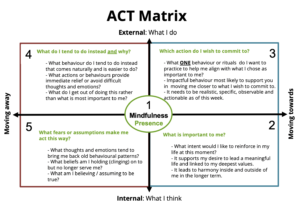
With that in mind, we use a matrix adapted from ACT:
All day long, we’re either doing what we call “towards moves” or “away moves.”
TOWARDS MOVES refer to responding according to our values and behaviours, which will lead us towards what really matters to us, expanding our potential for having a rich and meaningful life.
AWAY MOVES refer to reacting with often unconscious and conditioned beliefs, thoughts, emotions that lead to behavioural choices that keep us at bay from whom we really want to be.
The less aware we are of what is driving our choices, the easier it is to lose sight of what really matters — and the more we get stuck and move away from what we really want and need for a thriving life.
A more meaningful and fulfilling life begins with clarifying what is important to us, learning how to mindfully disengage from habitual thoughts and behaviours that take us away from what’s important and choosing moves that lead us in a healthy direction.
Now, you can draw a blank ACT Matrix on a piece of paper and fill it up to start building your own mental wellness plan.
Sex After Brain Injury: What Does This Look Like for Me?
= Authors =
Gabi Kaplan, Student Occupational Therapist
Jenni Diamond, OT Reg. (Ont.)
Evan Cole Lewis, MD
Sexual Function following a Brain Injury
Sustaining a brain injury can lead to a variety of physical, cognitive, emotional, and behavioural issues that can change your sexual functioning and intimacy experiences.
Women & men may experience sexual issues differently
For instance, following a brain injury, you may be experiencing (1,2):
Decreased or increased desire to have sex
Decreased arousal
Decreased quality of sex
Difficulty or inability to reach climax/orgasm
Inadequate energy for sex
Women and men may experience sexual issues differently (2).
Some of the most commonly reported issues following a brain injury are (2):
Women
Men
Difficulties with initiation and arousal
Difficulties initiating sex
Difficulties with orgasm, or reduced sensation
Difficulties reaching orgasm, or less intense orgasm
Difficulties with lubrication, leading to vaginal dryness
Getting and maintaining an erection
Painful sex
Premature ejaculation
Discomfort in positioning
Body positioning and movement
Changes in menstruation
Inability to masturbate
These changes in sexual function might be due to (1,2,5):
Disruption of normal brain functions
Hormonal changes
Autonomic dysfunction (see explanation below)
Medication side effects
Fatigue
Movement and balance issues
Self-esteem issues
Changes in thinking
Emotional changes
Changes in relationships
Autonomic Dysfunction and Concussions
Following a concussion (also known as a mild traumatic brain injury), you might be experiencing similar sexual functioning issues that are listed above. One plausible reason for your changes in sexuality may be due to autonomic dysfunction, which can occur after a mild traumatic brain injury (mTBI) or concussion (3).
… one plausible reason for your changes in sexuality may be due to autonomic dysfunction…
Our autonomic nervous system is involved in influencing certain involuntary bodily functions, such as our:
Heart rate
Blood pressure
Digestion
Urination
Sexual arousal & orgasm
In fact, innervation of sexual organs is primarily mediated by the autonomic nervous system (4). So when this system is not properly functioning, your sexual response can be impacted.
What can I do to improve sexual functioning and intimacy?
Communicate with your partner
Don’t assume your partner knows exactly what you are going through. Try your best to be as open as possible when speaking about all aspects of your brain injury, including your sexual issues.
Plan and prepare for sexual activities (1,2)
Plan sexual activities for when you have the most energy and are less tired
Limit distractions in the environment (for example, set up a quiet room with limited background noise)
Create a relaxing and sensual environment (for example, light candles or have a warm bath together beforehand)
Stay hydrated before and after sex
Pay attention to your body position during sex (1,2)
When having sex, position yourself so that you are not causing pain or dizziness. If you are having balance issues, position yourself to avoid falling or exacerbating the symptoms.
Try new things to increase arousal and/or comfort (1,2)
If you are having difficulties getting aroused, try watching movies or reading books/magazines with sexual content. Additionally, try initiating sexual activity with foreplay, which can help psychologically and physically prepare you for sex. If penetration causes pain due to vaginal dryness, consider using a lubricant.
… your doctor, nurse practitioner, occupational therapist or psychotherapist… may be able to help you in identifying the underlying issue, manage your symptoms, and help develop a solution.
Speak with your healthcare provider and seek advice (1,2)
This might include your doctor, nurse practitioner, occupational therapist or psychotherapist. They may be able to help you in identifying the underlying issue, manage your symptoms, and help develop a solution. Often, speaking about sex and sexual issues makes people feel uncomfortable or embarrassed. Try to remember that sexual activity is a normal aspect of our everyday lives. In addition to speaking to healthcare professionals, you may choose to talk to close friends or family members.
References:
Model Systems Knowledge Translation Center (2011). Sexuality after traumatic brain injury. Retrieved from: https://mrri.org/wp-content/uploads/2016/02/tbi_sexuality_moss_.pdf
Ahmad, T. & Yeates, G. (2017). Sex and sexuality after brain injury. Headway: the brain injury association. Retrieved from: https://www.headway.org.uk/media/4995/sex-and-sexuality-after-brain-injury-e-booklet.pdf
Esterov, D., & Greenwald, B. D. (2017). Autonomic Dysfunction after Mild Traumatic Brain Injury. Brain sciences, 7(8), 100. doi:10.3390/brainsci7080100
Kaplan, H. I. & Sadock B. J. (1995). Comprehensive Textbook of Psychiatry. 1(6) 1296
Purves D, Augustine GJ, Fitzpatrick D, et al., (2001). Autonomic Regulation of Sexual Function. Neuroscience. 2nd edition. Sunderland (MA): Sinauer Associates. Retrieved from: https://www.ncbi.nlm.nih.gov/books/NBK11157/
Trust Your Gut: The Gut-Brain Axis
= Gabi Kaplan, Laura Diamond, Jenni Diamond, OT Reg. (Ont.), & Evan Cole Lewis, MD =
What is the Gut-Brain Axis?
Have you ever wondered why we use the expressions “gut-feeling” or “butterflies in your stomach?” These phrases stem from the connection between our gut health and brain function. This connection is called the Gut-Brain Axis, which is a bi-directional communication network that links the central nervous system (the brain and spinal cord) with the enteric nervous system (the digestive system) (1). Your brain and digestive system send messages to each other and can affect one another’s health and functioning.
Disturbances to the gut-brain axis may be associated with many neurological conditions, some of which include anxiety, depression, autism spectrum disorder, Alzheimer’s disease, and Parkinson’s disease (1).
What happens to our gut when there is trauma to our brain?
People who have experienced a traumatic brain injury (TBI) may undergo a disruption to the gut-brain axis and gastrointestinal (GI) changes. TBI can induce both structural and functional changes to the gut including (2):
Structural: damage to the tissue lining the GI tract (2).
People who have experienced a traumatic brain injury (TBI) may undergo a disruption to the gut-brain axis and gastrointestinal (GI) changes.
Can targeting our gut assist in brain injury recovery?
Current research is exploring the possibility that interventions targeting our gut may assist in brain injury recovery and improve cognitive function. Some interventions that are currently being assessed include (1):
Pre- and probiotics
Nutritional interventions
Dietary vitamins and supplements
Fecal microbiota transplant
Enteral antibiotics
As more research is done, gut-brain axis interventions may indeed pose as a therapy option for brain injury recovery.
As more research is done, gut-brain axis interventions may indeed pose as a therapy option for brain injury recovery. And the next time that you have butterflies in your stomach, take care of your gut and you will be taking care of your brain!
References
Zhu, C. S., Grandhi, R., Patterson, T. T., & Nicholson, S. E. (2018). A Review of Traumatic Brain Injury and the Gut Microbiome : Insights into Novel Mechanisms of Secondary Brain Injury and Promising Targets for Neuroprotection, 8(6).
Sundman, M. H., Chen, N., Subbian, V., & Chou, Y. (2017). Brain , Behavior , and Immunity The bidirectional gut-brain-microbiota axis as a potential nexus between traumatic brain injury , inflammation , and disease. Brain Behavior and Immunity, 66, 31–44. https://doi.org/10.1016/j.bbi.2017.05.009
Tics & Tourette Disorder: Should You Be Concerned?
=== Jordan J. Ghassemian & Evan Cole Lewis, MD ===
About Tics
Tics are more common than people tend to think, and are experienced in some of the following ways:
Movement Tics such as:
Blinking
Shoulder shrugging
Vocal Tics such as:
Sniffing
Throat clearing
There are four ways to categorize tics:
Provisional Tics
Persistent Motor Tics
Persistent Vocal Tics
Tourette Disorder
Time
Less than 1 year
More than 1 year
More than 1 year
More than 1 year
Type of Tics
Motor and/or Vocal
Motor only
Vocal only
Motor and Vocal
Age of Onset
Less than 18 yrs old
Less than 18 yrs old
Less than 18 yrs old
Less than 18 yrs old
All of the above conditions improve as children age, and the majority tend to “grow out” of their tics around early adolescence.
Conditions like Obsessive-Compulsive Disorder (OCD) and Attention-Deficit Hyperactivity Disorder (ADHD) are more common in children with tics (1, 2). They are also more common in individuals diagnosed with Tourette Disorder compared to the other categories.
How are tics treated?
Tics are harmless and do not result in any injury to the brain. They tend to improve with time whether they are treated or not. Usually left alone, the child will show improvements on his or her own.
Although medication may be beneficial to reduce the frequency and intensity of tics, they often do not go away with medication.
Some medications used to treat tics include:
Guanfacine
Clonidine
Antipsychotic medications, such as Risperidone
Another treatment option is behavioral therapy. This can help children control the urge to exhibit tics, and may be as effective as using medication.
References
1. Charf, J. M., Miller, L. L., Mathews, C. A., & Ben-Shlomo, Y. (2012). Prevalence of Tourette Syndrome and Chronic Tics in the Population-Based Avon Longitudinal Study of Parents and Children Cohort. J Am Acad Child Adolesc Psychiatry, 51, 192-201. doi:10.1016/j.jaac.2011.11.004
2. Freeman, R. D., Fast, D. K., Burd, L., Kerbeshian, J., Robertson, M. M., & Sandor, P. (2007). An international perspective on Tourette syndrome: selected findings from 3500 individuals in 22 countries. Developmental Medicine & Child Neurology, 42(7), 436-447. doi:10.1111/j.1469-8749.2000.tb00346.x